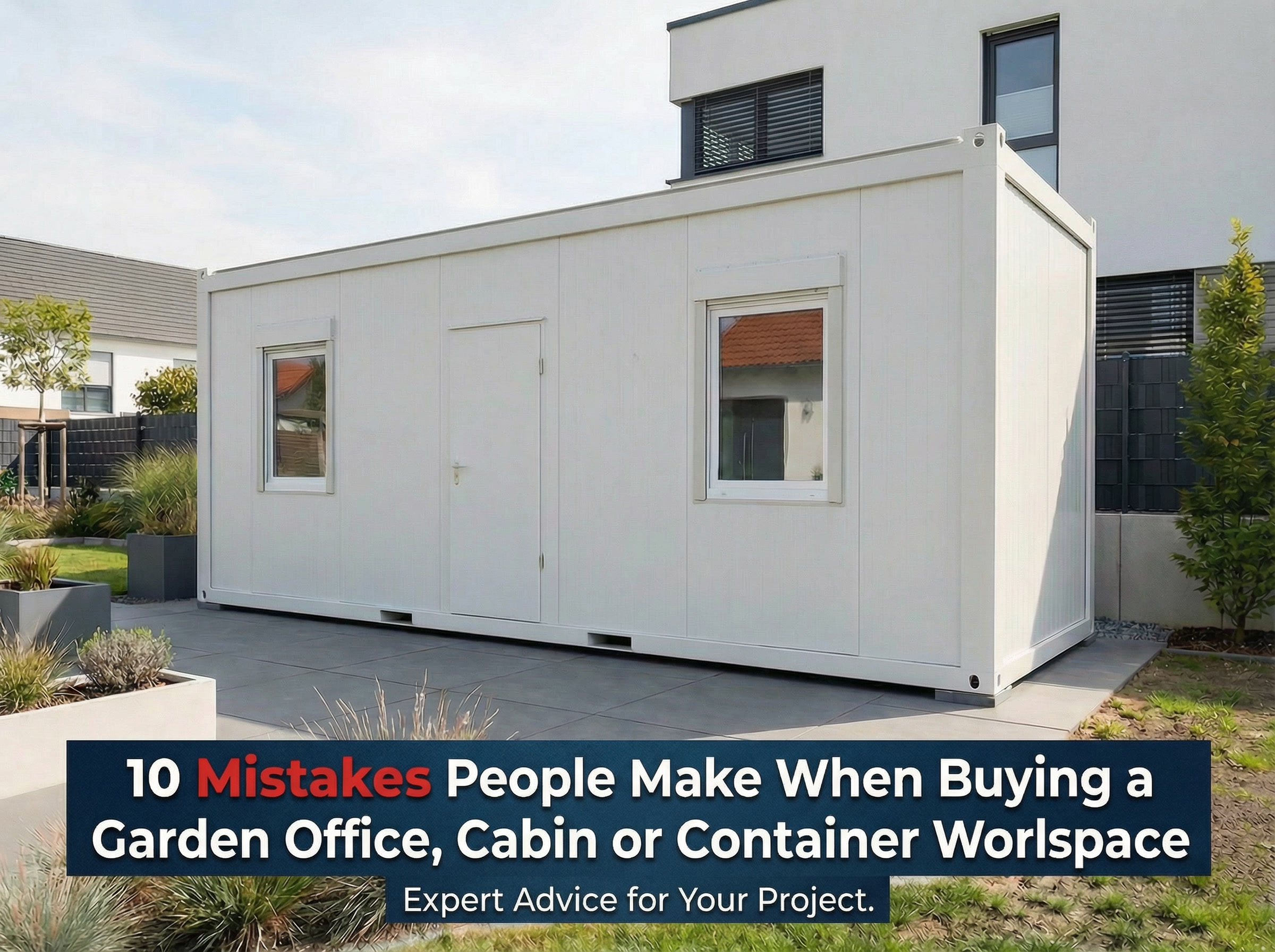
10 Mistakes People Make When Buying a Garden Office, Cabin or Container Workspace
At some point the house stops working for work.
The kitchen table becomes an office.
Meetings happen with kids running around in the background.
Equipment slowly takes over spare rooms.
So people start looking into garden cabins, container offices, or small modular workspaces.
Then they open Google and see prices ranging from a few thousand pounds to well over £30,000.
And that’s usually where the confusion begins.
Planning rules are unclear.
Some suppliers sell basic converted containers.
Others offer fully insulated modular buildings.
Most buyers are just trying to answer one question:
“What actually works and what mistakes should I avoid?”
After installing these buildings for many different uses — home offices, therapy rooms, studios and workshops — the same problems tend to show up again and again.
Here are the ones worth knowing before you order anything.
1. Buying a building before checking planning
This is the most common issue.
Many smaller garden buildings fall within permitted development rules, but that doesn’t automatically apply in every situation.
Planning requirements usually depend on things like:
height of the building
distance from boundaries
intended use
whether clients or customers will visit
A small office used occasionally is very different from a treatment room with daily appointments.
The easiest projects usually start with planning questions first and buildings second.
2. Buying something too small
Most people begin with the smallest option possible.
A 10ft unit often looks fine when you imagine a desk and chair.
Then you start adding real life:
storage
visitors or clients
equipment
heating and ventilation
Suddenly the space feels tight.
Many buyers end up wishing they had chosen a slightly larger building once they begin using it daily.
3. Forgetting the base and groundworks
Online listings usually show the building price.
What people forget is that the building needs something solid underneath it.
Typical bases include:
concrete pads
strip foundations
ground screw systems
The correct base depends on the size of the building and the ground conditions.
Skipping proper preparation often leads to movement, drainage problems or difficulty installing the unit properly.
4. Not thinking about power and internet early
A workspace needs more than four walls.
Most installations require:
electrical connection
heating
lighting
reliable internet
Running cables after the building arrives can be far more difficult than planning it beforehand.
The easiest projects usually plan the services at the same time as the building layout.
5. Ignoring delivery access
This catches people off guard surprisingly often.
Cabins and container units usually arrive on a large lorry or crane truck.
If the building needs to travel through a narrow driveway, under trees or past overhead cables, delivery becomes more complicated.
Checking access early avoids surprises when the installation date arrives.
6. Choosing purely on price
When you start researching these buildings you’ll see a wide range of prices.
That’s because they’re built very differently.
Basic container conversions often include minimal insulation and basic finishes.
Purpose-built modular buildings are designed for regular daily use and typically include better insulation and internal finishes.
Both options can work depending on the situation, but it helps to understand what you’re actually comparing.
7. Forgetting how the building will actually be used
A quiet home office has very different requirements compared with:
a therapy room
a fitness studio
a meeting space for clients
The building layout, insulation, lighting and heating all depend on what will happen inside the space.
Thinking about the real daily use of the building helps avoid compromises later.
8. Underestimating the full project cost
The building itself is only one part of the project.
Other costs may include:
groundwork and base preparation
delivery and crane lift
electrical connection
internal layout changes
Most installations are straightforward once the full scope of the project is understood.
Problems tend to arise when people only budget for the building itself.
9. Rushing the decision
Garden offices and container workspaces often look simple.
In reality they sit somewhere between a piece of furniture and a small building project.
Taking a little time to plan properly usually leads to better results than ordering the first building that looks right online.
10. Not speaking to someone who installs them regularly
Many suppliers simply sell buildings.
The installation side — planning, base preparation, delivery logistics — is often where most of the complexity sits.
Talking to someone who deals with these projects regularly can answer many questions quickly before decisions are made.
Because these questions come up so often, we ended up putting together a short guide that walks through the things most buyers ask before ordering a cabin or container workspace.
It covers:
planning considerations
choosing the right size
base preparation
delivery access
power and utilities
typical project costs
If you're still at the early research stage, you can download the guide here:
Download the Garden Cabin & Container Workspace Buyer’s Guide - https://www.ccpmodular.co.uk/resources
It’s designed to help people think through the project properly before buying anything.
Most people read this guide before ordering a building so they don’t miss something important.
