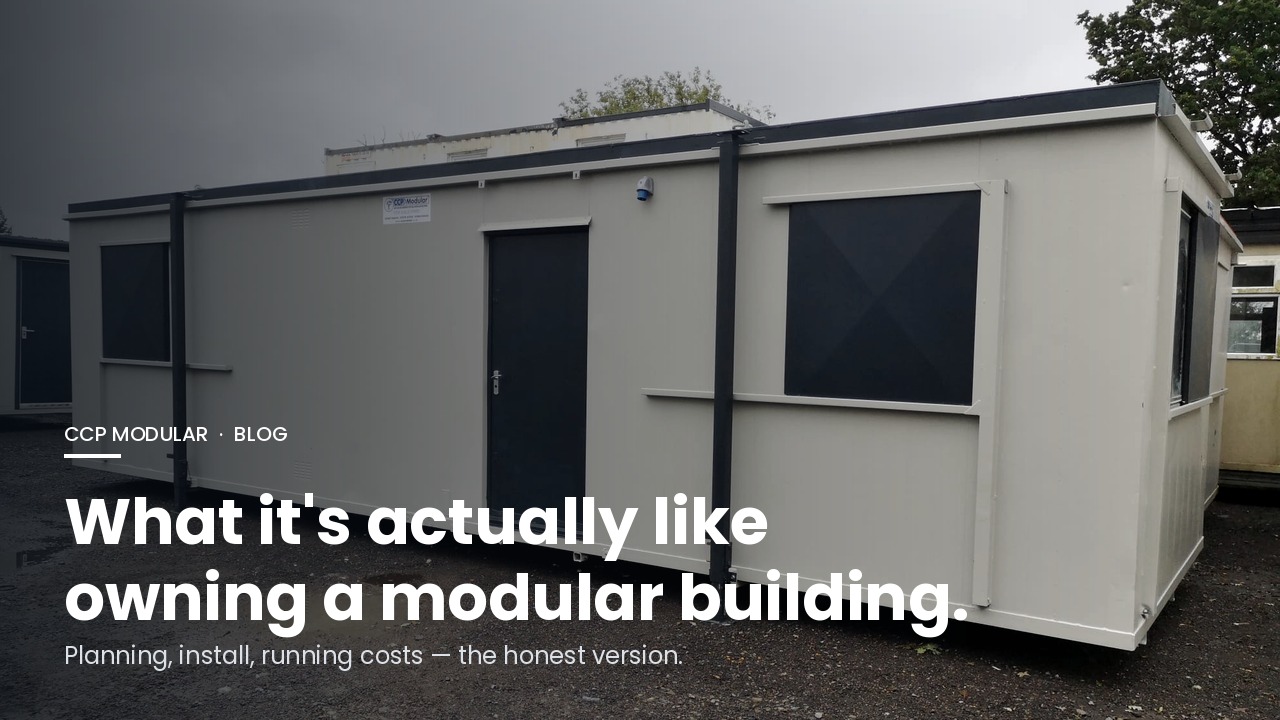
What It’s Actually Like Owning a Modular Building (6 Months Later)
Most people spend weeks — sometimes months — deciding whether to buy a modular building.
Planning.
Costs.
Comparing options.
Trying not to get stitched up by a cheap unit.
Then it arrives, gets installed… and that’s where most advice stops.
What people actually want to know is what happens after.
Because that’s where the real decision sits.
First 2 Weeks: The Excitement (and a few surprises)
When the building lands, it’s usually a good day.
It looks better than expected, especially if it’s been done properly — full insulation, electrics done right, doors that actually shut properly. You feel like you’ve added something solid to the property.
But there are always a couple of things people don’t expect:
You’ll tweak the layout mentally straight away (“should’ve put the door here…”)
You notice how important access is (paths, steps, lighting — not always planned properly)
If it’s for work, you realise quickly whether it actually suits how you operate day-to-day
Nothing major. But it’s where reality starts to replace the idea.
Month 1–3: This is where it either works… or doesn’t
This is the phase no one talks about.
Because this is where the building either becomes part of your life — or just sits there.
From what we’ve seen, it comes down to one thing:
Was there a clear use before it was built?
The ones that work:
PT studios with clients booked in from day one
Offices where someone already had work spilling into the house
Therapy rooms with a waiting list
The ones that struggle:
“It’ll be handy to have”
“I’ll figure it out after”
Oversized buildings with no defined use
That’s where buildings end up half-used. Not because the building’s wrong — but because the plan was.
The Money Side (what actually happens)
There are two ways people justify these:
Saving money (usually rent)
Making money (business use)
Here’s the reality.
If it replaces rent:
It nearly always stacks up.
Say someone’s paying £400–£800/month for space — within a couple of years, the numbers make sense. After that, it’s theirs.
The only people who struggle here are the ones who:
weren’t actually using the rented space properly
or didn’t need it in the first place
If it’s for income:
This is where it varies.
We’ve seen:
PTs paying off a unit in under a year
Therapists fully booked within weeks
Small businesses doubling output
We’ve also seen:
spaces that never got marketed
rooms that stayed “nearly ready” but never launched
The building doesn’t create income.
It gives you the capacity to earn it.
Big difference.
Month 3–6: The reality settles in
By this point, the building has either:
become part of daily life
or it’s drifted into the background
The ones that succeed usually have:
routine use (same time every day or week)
a defined purpose
income or clear value attached to it
The ones that don’t tend to feel like:
a good idea that never quite landed
something that needs “sorting out” but keeps getting pushed back
This isn’t a building issue.
It’s a clarity issue.
Maintenance (what people don’t ask about)
This gets ignored completely when people are buying.
In reality, it’s straightforward — if the building’s been done properly.
You’re looking at:
occasional checks on electrics (same as any building)
keeping doors, seals and windows in good condition
making sure airflow is right (especially in winter)
external finishes depending on what you’ve chosen (cladding, etc.)
If it’s a cheap unit, this is where problems show up:
condensation
poor insulation
electrics that weren’t done to standard
That’s usually where the “cheap option” ends up costing more.
What People Usually Wish They’d Done Differently
This comes up a lot after a few months:
Gone slightly bigger (but only if the use justified it)
Thought more about layout — doors, windows, internal flow
Sorted access properly (paths, lighting, how people arrive)
Had a clearer plan before installing it
Very rarely do people regret having the building.
They regret not thinking through how they’d actually use it.
So… is it worth it?
In most cases, yes.
But not for the reasons people think.
It’s not just about: saving rent, adding space, or “having something on the property”
The ones that get real value are the ones who:
needed the space before they built it
had a clear use from day one
treated it like part of their business or routine, not an add-on
That’s where it becomes an asset.
Everything else sits somewhere in the middle.
If you’re at the stage where you’re considering one, the conversation shouldn’t start with size, price, or even the building itself.
It should start with:
“What is this actually going to be used for — day to day?”
Once that’s clear, everything else tends to fall into place properly.
If it’s not, that’s where mistakes creep in.
