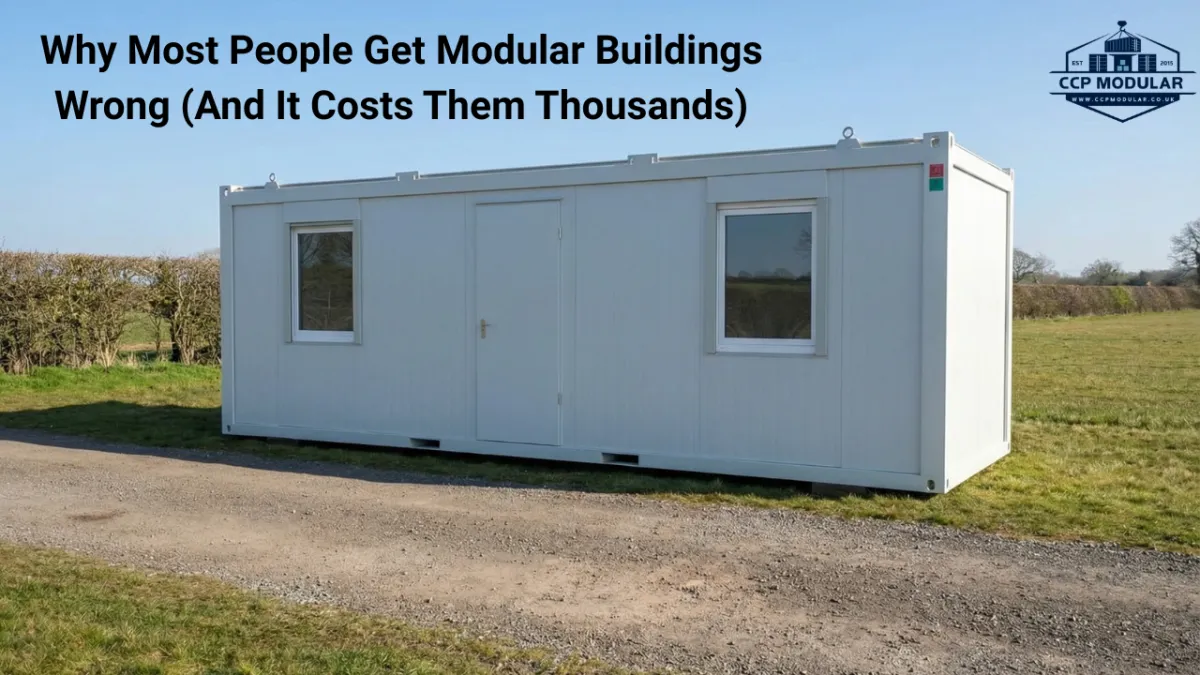
Why Most People Get Modular Buildings Wrong (And It Costs Them Thousands)
Why Most People Get Modular Buildings Wrong (And It Costs Them Thousands)
There’s a pattern you start to notice after a while.
Someone comes to us frustrated. They’ve either already bought a unit that doesn’t do what they expected… or they’re stuck halfway through because something didn’t get approved.
It usually starts the same way.
They thought it would be simple.
Buy a unit. Drop it on site. Job done.
In practice, it rarely works like that.
The first mistake — assuming “modular” means plug-and-play
On paper, modular sounds easy. And sometimes it is.
But only if three things line up properly:
planning position
ground conditions
intended use
Miss one of those and the whole thing slows down.
A typical example — someone buys a unit thinking it falls under permitted development. Then finds out it doesn’t because of how it’s being used (business vs personal), or where it’s placed on the land.
At that point, you’re not just waiting… you’re paying twice. Once for the unit, once to fix the mistake.
The second mistake — going too cheap
This one’s more common than people think.
You’ll see units advertised thousands cheaper. Looks similar in photos. Sounds similar in the description.
Then it lands on site.
Insulation isn’t right. Electrics aren’t compliant. Doors don’t seal properly. Condensation becomes a problem within weeks.
This isn’t theory — it’s what happens when units are built to hit a price, not a standard.
And the issue isn’t just comfort. It affects:
long-term durability
safety
whether it can legally be used for certain purposes
Fixing it afterwards usually costs more than doing it properly in the first place.
The third mistake — not thinking about the full system
Most people focus on the unit.
They don’t think about everything around it.
Access. Delivery. Groundworks. Services. Drainage. Positioning. Future expansion.
That’s where projects either run smoothly… or become stressful.
A simple example — delivery.
If access is tight or you need a crane, that can add £1,500–£2,000 straight away. If that wasn’t planned for, it throws the whole budget off.
Same with groundworks. A “cheap unit” on a bad base becomes an expensive problem very quickly.
The part no one really explains — planning and funding
This is where most people get stuck.
Not because it’s impossible — but because it’s unclear.
There are cases where:
planning isn’t needed
planning is straightforward
funding or grants are available
But it depends heavily on the use case.
A school, a community project, a fitness space, or even a home office all fall under different rules.
That’s why people end up going in circles. They’re trying to apply general advice to a specific situation.
What actually works (from experience)
When projects go well, they usually follow a different path.
Not rushed. Not guesswork.
Just a bit more thought upfront:
clarify the use first
check planning position early
design around the site, not just the unit
build with proper materials, even if it costs slightly more
understand full costs before committing
Nothing complicated. Just fewer assumptions.
Where people usually end up
By the time most people reach out, they’re in one of three positions:
They’ve already bought something that doesn’t quite work
They’ve been quoted wildly different prices and don’t know who to trust
They’ve delayed the decision for months because it feels unclear
All of those are avoidable.
The reality
Modular is one of the fastest ways to create space.
But it’s not “buy a box and you’re done”.
It’s a small project. And like any project, it either runs clean… or it doesn’t.
The difference is usually decisions made early on.
If you’re even slightly unsure about planning, costs, or what actually works for your situation, it’s worth getting that clarity before you commit to anything.
That’s normally the point where things either become simple… or expensive.
