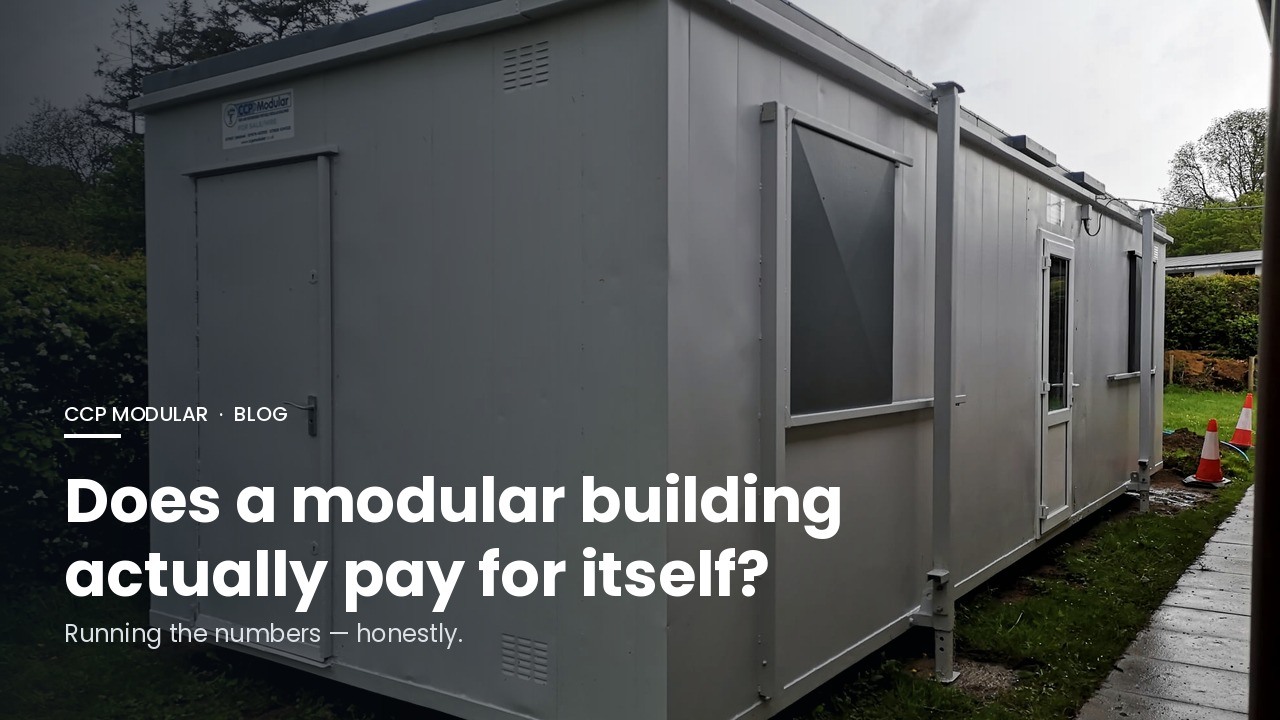
Does a Modular Building Actually Pay for Itself?
This is usually one of the first questions people ask.
“Will it pay for itself?”
Short answer — sometimes.
Long answer — depends what you’re using it for.
The mistake most people make
They treat it like a guaranteed investment.
It’s not.
A modular building doesn’t automatically make money. It just gives you the space to either:
stop spending money elsewhere
or earn money from it
If neither of those happen properly, it won’t “pay for itself” in any meaningful way.
Scenario 1: Replacing rent
This is where it usually makes the most sense.
If you’re currently paying for space — office, studio, treatment room — the maths is fairly simple.
Say you’re spending:
£400/month → £4,800/year
£800/month → £9,600/year
Over a couple of years, that adds up quickly.
A lot of the people we deal with are in that position. They’re already paying for space, just not owning it.
So instead of money going out every month, it goes into something they keep.
That’s where it tends to stack up well.
Where this can still go wrong
Even here, there are a couple of catches.
If you weren’t actually using the rented space properly to begin with…
or you don’t really need it…
Then replacing it doesn’t fix anything.
You’ve just moved the same problem onto your own property.
Scenario 2: Using it to generate income
This is where things vary a lot more.
We’ve seen:
PTs fully booked and covering the cost quickly
Therapists running consistent sessions week in, week out
Small businesses scaling up because they’ve got proper space
In those cases, yes — it can pay for itself fairly quickly.
But we’ve also seen the other side.
People who never quite launch properly
Spaces that are “nearly ready” but never finished
No marketing, no structure, no consistency
In those situations, it doesn’t matter how good the building is.
It won’t generate anything.
Rough timelines (what we actually see)
Not exact, but realistic.
Replacing rent: usually 2–4 years to balance out
Active business use: can be much quicker (sometimes under 12 months)
Low or inconsistent use: doesn’t really pay back at all
That’s the honest version.
The hidden costs people forget
This is where people sometimes get caught out.
Not big costs, but they exist:
groundwork or base
electrics connection
internal setup (furniture, layout, etc.)
access (paths, lighting, steps)
If you don’t account for those early, the overall cost creeps up.
What actually makes it “worth it”
It’s not just about direct money.
The ones who get the most value usually have one of these:
they’ve got control over their own space
they’ve cut out travel and wasted time
they’re not relying on landlords or availability
they’ve got somewhere that actually works for how they operate
Hard to put a number on that, but it matters.
Where people get caught out
This is the bit worth paying attention to.
It doesn’t pay for itself when:
there’s no clear use from the start
it’s built “just in case”
there’s no routine or structure around using it
it’s expected to create income without any plan behind it
That’s where it ends up being an expensive extra.
So… does it pay for itself?
It can.
But only if it’s doing something real:
replacing a cost
or generating income
ideally both
If it’s not, it’s just sitting there.
If you’re at the stage of working it out, it’s usually worth looking at your current setup first.
Where’s money going out now?
Where could it realistically come back in?
That tends to give you a much clearer answer than just looking at the building itself.
